
Blog
 Sep29
Sep29
Solar Backup Explained: Series vs Parallel Connections
Blackout backup performance depends heavily on one decision that’s often underexplained at the point of sale: whether your battery inverter is wired in series or in parallel with the incoming electricity supply. This series vs parallel solar battery decision isn’t a brand or quality issue, plenty of excellent hybrid inverters use either wiring method. It’s an architecture choice, and it directly determines what keeps running, and what doesn’t, during a grid outage.
Series vs Parallel Solar Battery: The Core Difference
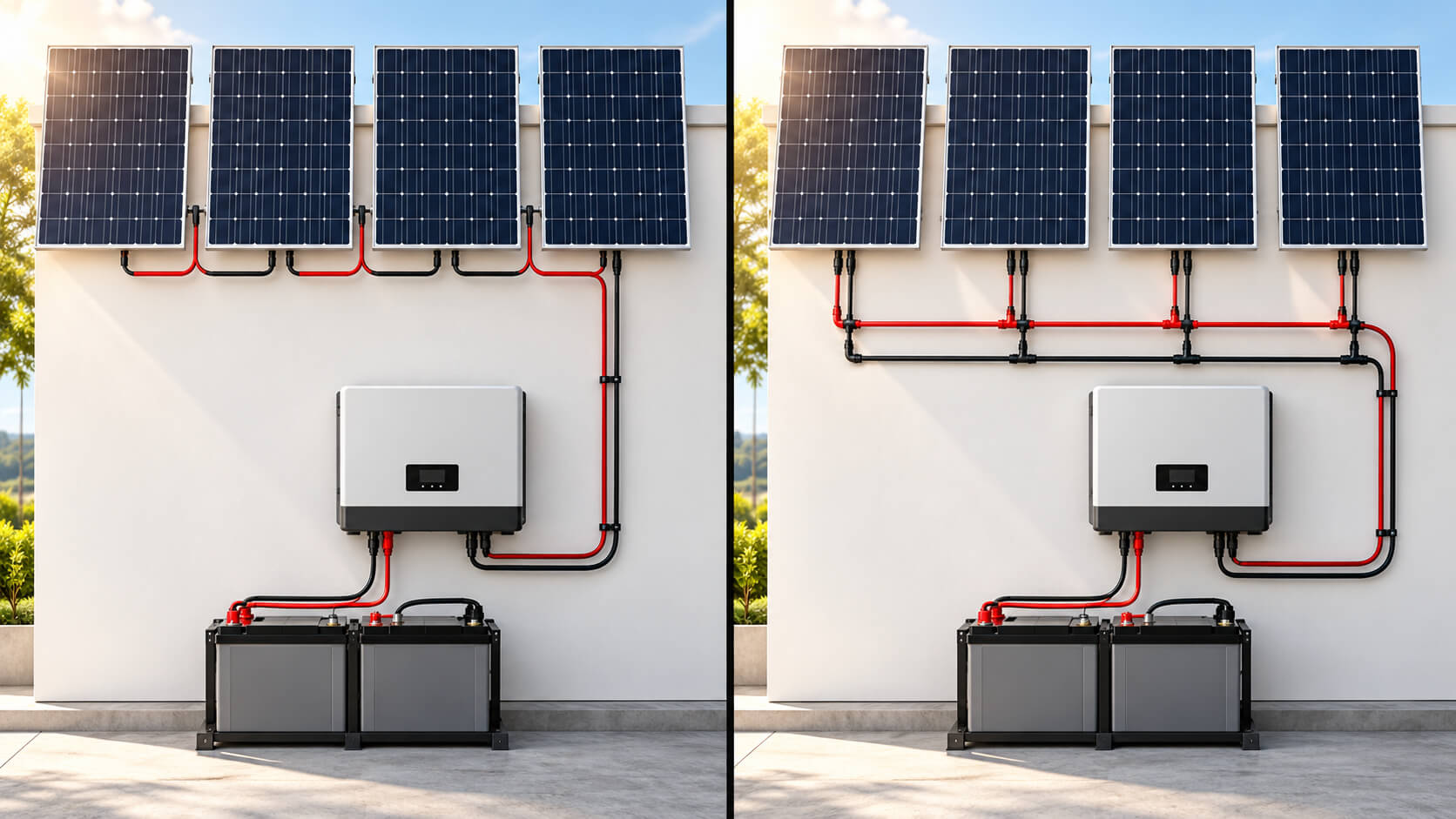
In a series-connected solar battery system, incoming mains power is routed through the battery inverter before it reaches the switchboard. The inverter becomes the gateway between the grid and the home, so if it ever fails, everything wired downstream loses power too, regardless of whether the grid is still up.
A parallel-connected solar battery system works differently. The inverter sits alongside the grid supply rather than intercepting it, and a separate gateway device handles isolating the grid during an outage. Because the inverter isn’t sitting in the main supply path, a fault in a parallel-connected battery doesn’t take the grid connection down with it.
Series-connected hybrid inverters tend to show up in more cost-accessible product lines, including GoodWe and Alpha ESS. Parallel-connected systems include the Tesla Powerwall 3 and Sungrow batteries, with Sungrow also offering a hybrid “energy bridge” option for more flexible parallel setups.
Series vs Parallel Solar Battery: Quick Comparison
| Feature | Series | Parallel |
| Wiring position | Inline with mains supply | Alongside mains supply |
| If inverter fails | Downstream circuits lose power | Grid connection unaffected |
| Best suited to | Battery close to switchboard | Battery and solar in separate structures |
| Cable cost over distance | Rises sharply with distance | Stays low, only needs a comms cable |
| Common brands | GoodWe, Alpha ESS | Tesla Powerwall, Sungrow |
| Typical cost | Lower for short cable runs | Higher upfront, lower long-run cable cost |
Series Connected Solar Battery: Best Use Cases
A series-connected solar battery makes the most sense when your battery and switchboard are already close together, since cable runs stay short and cheap. It’s also a solid fit if budget is the deciding factor and you’re comfortable with the trade-off: if the inverter ever faults, your whole home loses power until it’s fixed. Homes with straightforward layouts, single dwellings, or renovations where the switchboard and battery bay sit in the same wall cavity are where this setup earns its keep. If you’re not running critical medical equipment or work-from-home gear that can’t afford downtime, series is often the more practical, lower-cost pick.
Parallel Connected Solar Battery: Best Use Cases
Parallel setups shine when the battery has to live somewhere the switchboard doesn’t like: a detached garage, shed, or a granny flat with its own power run. Because the inverter isn’t sitting inline with the grid, a fault there won’t take your whole house down with it, which matters if you rely on constant power for things like a home office, freezers, or medical devices. It also suits properties where cable distance would otherwise blow out the budget, since parallel systems only need a comms cable rather than a full mains run. If resilience and flexibility matter more than upfront cost, parallel is usually the better call.
Partial vs Whole Home Battery Backup: What’s the Difference?
Most solar battery backup systems aren’t sized for whole home battery backup. A typical setup covers the fridge, lights, internet, and a small air con load, while ovens, ducted air con, pool pumps, and EV chargers are usually first to go. If a specific appliance matters during an outage, name it at quoting stage rather than assuming it’s included.
Also Read: 5 Essential Checks to Do Before Your Battery Installer Leaves
Single-Phase vs Three-Phase Solar Battery Backup Explained
Backup capacity from a hybrid inverter gets divided across phases, not delivered in full to each. A 15kW inverter on single-phase delivers its full output wherever needed; the same inverter on three-phase delivers only around 5kW per phase. That’s often not enough to run an air con compressor alongside the fridge on one phase, so three-phase properties usually need a larger inverter than their average load suggests.
Series vs Parallel Solar Battery: Which Should You Choose?
Neither wiring method is better outright; the right choice depends on where your switchboard, battery, and solar panels need to sit. If you’re weighing up a battery installation and want the right connection type and product matched to your property, get in touch with the Sunburn Solar team before you sign anything.
© 2026 sunburnsolar.com.au. All rights reserved. - Restructuring Practitioner Appointed
Powered by: